
CONTACT
1200 W Iowa Ave, Indianola
716-507-7287
https://www.facebook.com/karenbuddhistassociationofiowa
HOURS
Doesn’t hold weekly meetings
ETIQUETTE
Greetings adapted to Western culture and are done shaking hands with the right and supporting that arm with the left hand, using two hands is a sign of respect.
Direct eye contact can be disrespectful as it shows equal status, crossing arms is also considered disrespectful as well as showing the bottom of your feet or touching your head.
Directness is viewed as benign and rude and rushing schedules is frowned upon because it could leave some people behind.
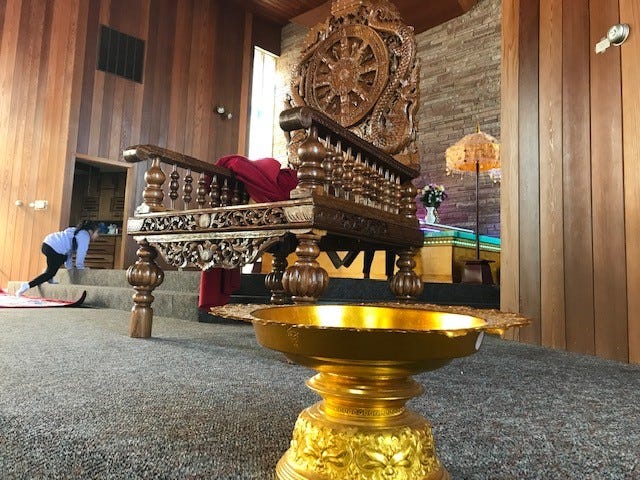
Remove shoes
Don’t point outstretched legs (soles of feet) at holy objects (altars, statues) or people (monks)
STUDENT TESTIMONIAL
By: Natasia
History
Originated from Burma (Myanmar). Came to the United States as refugees mostly from refugee camps in Thailand. Came to Iowa working in meat packing because of the high wages. Began meeting in homes and eventually bought a house to hold meetings. Later sold that house to buy an old Catholic church in Indianola. Became an association in the early 2000s.
Practices/Services
Karen New Year is celebrated in January. Also, in January the monks give teachings. In February there is a rice festival involving a special rice that is cooked once a year. The rice is cooked in the parking lot over a wood fire and members take the rice home. In April there is a water festival. This water festival is also celebrated in Burma, where the seasons are different. The elders are also celebrated in April by brushing oil on them and handing them an envelope with money in it. In July, men can become monks for a week and women can become nuns for a week. Their heads are shaved and they are given a robe. They practice meditation and teaching during this time. In September, there is a candlelight ceremony. In November, there are various festivals, which Karen Buddhists from all over the Midwest attend. Also, in November they make money trees and parade outside of the temple three times with their money trees. This helps raise money to maintain the temple. Other than these events the temple is normally empty except for special events like a wedding. The monks can’t eat after noon and don’t cook for themselves. This is similar to Burma, where different people provide food for the monks.
Distinctive Qualities
This community has two monks and two nuns that live at the temple.
Demographics
Made up of mostly refugees from Burma (Myanmar) and Thailand.
Branch
The community practices Theravada Buddhism.