
11/18/2027: Waleed El-Ansary, “Holistic Work and Islamic Economics”

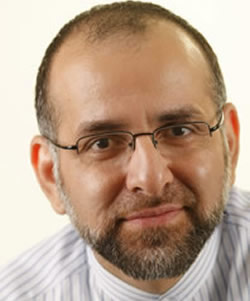
On Thursday, November 18 (2027) at 6:00 pm in Aliber 101 (2847 University Ave), Dr. Waleed El-Ansary, Helal, Hisham and Laila Edris El-Swedey University Chair in Islamic Studies at Xavier University, will lecture on “Holistic Work and Islamic Economics.”
The title of this talk suggests three questions: 1) What is holistic work? 2) How is it related to Islamic economics? and 3) Why does it matter and why is a new paradigm needed? Turning to the first question, holistic work is work that is spiritually, psychologically, and materially efficacious. It fulfills a hierarchy of spiritual and other human needs, including the need for meaning, self-realization, and participation in the community, and stands in contrast to what I shall term “deformed work,” that is, work that fulfills only materials needs, at least in the short to medium terms. In the long term, deformed work has arguably sown the seeds of dissatisfaction underlying many socio-economic and environmental crises at both national and international levels, as we shall see. Turning to the second question concerning how this subject relates to Islamic economics: a traditional Islamic economy is based on holistic rather than deformed work. This distinction has significant implications for the critique of both industrial capitalism and communism, economic systems structured largely on deformed work as viewed from an Islamic perspective. This distinction, in turn, calls into question some of the foundational assumptions of modern economic theory. Although I discuss the need for a new economic paradigm in the context of Islamic economics, the principles offered in this presentation resonate with the ethical and spiritual concerns of other major world religions. As such, they point toward the need for a broader, interreligious framework to confront shared global crises on the social, economic, and environmental levels. In this way, the significance of holistic work in Islamic economics speaks directly to the third question of why it matters today.

Dr. Waleed El-Ansary is the Helal, Hisham and Laila Edris El-Swedey University Chair in Islamic Studies at Xavier University, where he teaches courses on Islamic studies, Islamic economics, and religion and science. He holds a Ph.D. in Islamic and Religious Studies from George Washington University and M.A. in Economics from the University of Maryland. His research focuses on the intersection of religion, science, and economics. He has authored numerous publications, including “Islamic Environmental Economics and the Three Dimensions of Islam” in his co-edited volume Muslim and Christian Understanding: Theory and Application of A Common Word. His most recent book with Alexis Blum, Grand Rabbi Emeritus of Neuilly, and Bishop Claude Dagens, Bishop of Angouleme, is Know the Religion of Thy Neighbor, which was arranged through the UNESCO-based Aladdin project to help train young rabbis, priests/preachers, and imams (as well as any other interested parties) about the Abrahamic traditions for greater mutual understandi
07/12/2026: Interfaith Camp: Digital Story Screening

On Sunday, July 12 at 3:30pm in Meredith Hall 101 (1316 28th Street), we will screen the digital stories created by our campers at our 2026 Interfaith Youth Leadership Camp. A brief reception will follow.

Below please find information about this year’s camp:

This year (July 8-12) marks the 10th consecutive year of the interfaith youth leadership camp that we program in partnership with the Des Moines Area Religious Council. Campers at the camp learn about religious traditions and interfaith leadership, visit places of worship throughout the metro area, and create digital stories about personal faith experiences (that are screened for the public the last day of the camp). Through generous funding from Drake and DMARC, we provide housing (in the dorms at Drake), food (through Drake’s food service and the places of worship we visit), and a $250 “scholarship.” 

Below, you can find a short “teaser” video from past camps and flyers for this year’s camp.

2026 Interfaith Youth Leadership Camp

(Click here for an archive of digital stories created at our last nine camps.)

This year (July 8-12) marks the 10th consecutive year of the interfaith youth leadership camp that we program in partnership with the Des Moines Area Religious Council. Campers at the camp learn about religious traditions and interfaith leadership, visit places of worship throughout the metro area, and create digital stories about personal faith experiences (that are screened for the public the last day of the camp). Through generous funding from Drake and DMARC, we are able to provide housing (in the dorms at Drake), food (through Drake’s food service and the places of worship we visit), AND a $250 “scholarship.” 

(June 2 note: the application process is now closed.) Currently, we are accepting applications for this year’s camp. Campers are usually 16-18 years of age (with upper-class Drake students serving as counselors), i.e., rising juniors and seniors in high school and entering first-year college students. (Applicants need not be religious; we’ve had plenty of non-religious campers in the past.)

If you know of anyone who might be interested, please encourage them to reach out to comparison.project@drake.edu and/or apply through this link: www.dmarcunited.org/camp. There is over a month to apply, as the deadline is not until Sunday, May 31. 

04/19/2026: Meet My Religious Neighbor: Vaisakhi Service and Celebration

On Sunday, April 19, we will celebrate the annual holiday of Vaisakhi from roughly 12:00 to 2:00 pm with the Sikh gurdwara in West Des Moines, the Iowa Sikh Association (1115 Walnut St.).

The service will include many of the elements of a typical Sunday worship service: the signing of hymns (kirtan), reading from sacred scripture (Guru Granth Sahib), community prayers (aardas), and the sharing of the sacred sacrament (karah prashad, the so-called “holy pudding”), after which a free vegetarian meal will be served (langar). Dress modestly, remove shoes at door, and don a head scarf (available at the door for both women and men). Also, refrain from pointing outstretched legs toward the holy book/altar.

This event is part of the “Meet My Religious Neighbor” series, which is co-programmed with CultureALL, the Des Moines Area Religious Council, and Interfaith Alliance of Iowa.

Translate »